A few things from space that I find interesting: three signals that were received, and three messages that were sent.
Received
1977 · radio
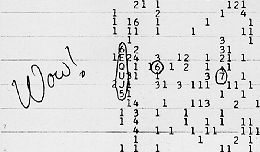
The Wow! signal
On 15 August 1977 the Big Ear radio telescope of Ohio State University recorded a strong narrowband signal near 1420 MHz, the frequency of neutral hydrogen. Jerry Ehman circled its intensity code, 6EQUJ5, on the printout and wrote “Wow!” beside it.
It lasted about 72 seconds, which is how long a fixed point in the sky took to drift through the telescope’s beam. Later searches of the same region never found it again. A 2025 reanalysis of the archival data favours a natural explanation, possibly a cold hydrogen cloud briefly brightened by a passing burst of radiation, but this is still a hypothesis.
Image: Big Ear Radio Observatory and North American AstroPhysical Observatory (NAAPO), public domain.
1999 · radio
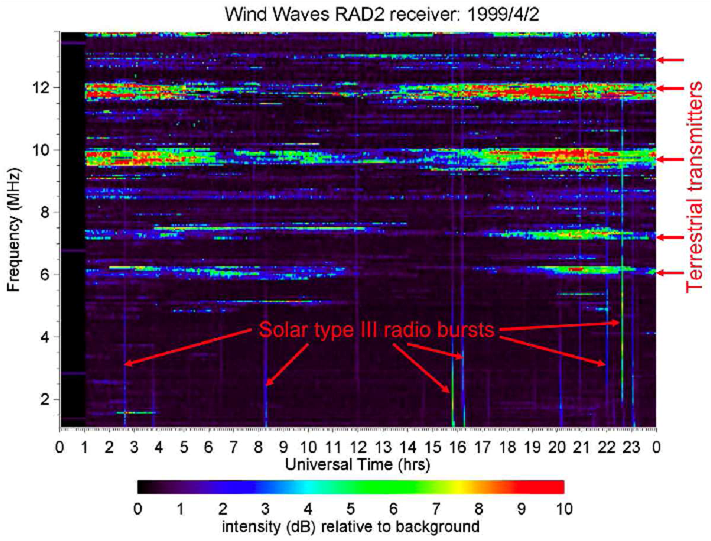
A day of the radio sky
This is one day, 2 April 1999, from the RAD2 receiver on NASA’s Wind spacecraft: time runs left to right, frequency bottom to top, and colour shows intensity.
The thin vertical streaks are solar type III radio bursts, produced by beams of electrons thrown out of the Sun by flares; they sweep from high to low frequency as the electrons travel outwards. The steady horizontal bands are radio transmitters on Earth. Both appear in the same picture, and only their shapes tell them apart.
On 15 October 1991 the Fly’s Eye detector at Dugway Proving Ground in Utah recorded a cosmic ray with an energy of (3.2 ± 0.9) × 10²⁰ eV. That is roughly the kinetic energy of a 140-gram baseball at about 100 km/h, carried by a single subatomic particle.
It is still the most energetic cosmic ray ever recorded. The second, nicknamed Amaterasu (about 2.4 × 10²⁰ eV), was seen by the Telescope Array in 2021 and reported in 2023. Where particles this energetic come from is not known.
Figure: drawn for this page from the published energies.
Sent
1974 · radio message
The Arecibo message
On 16 November 1974 the Arecibo telescope in Puerto Rico sent a 1,679-bit message towards the globular cluster M13, about 25,000 light-years away. It was transmitted once, at 2,380 MHz, in under three minutes.
1,679 is the product of two primes, 23 and 73, so a receiver can try arranging the bits into 73 rows of 23. Doing that gives a picture: the numbers 1 to 10, the atomic numbers of the elements in DNA, a double helix, a human figure, the Solar System and the telescope itself. Frank Drake designed it with colleagues at Cornell, including Carl Sagan.
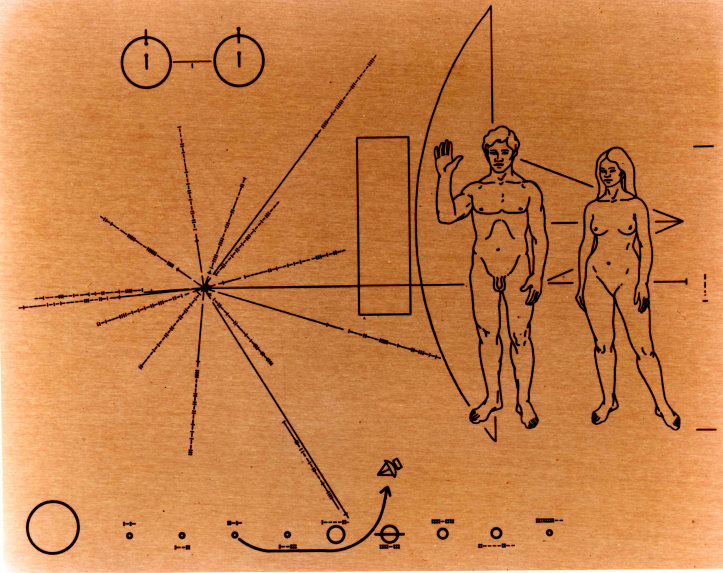
Pioneer 10 (1972) and Pioneer 11 (1973) each carry a gold-anodised aluminium plaque, 9 by 6 inches, designed by Carl Sagan and Frank Drake with artwork by Linda Salzman Sagan.
It uses the hydrogen spin-flip transition (21 cm, 0.7 ns) as a unit of length and time. A map of 14 pulsars, each labelled with its period, locates the Sun. It also shows a man and a woman to scale against the spacecraft, and the Solar System with the spacecraft’s path past Jupiter.
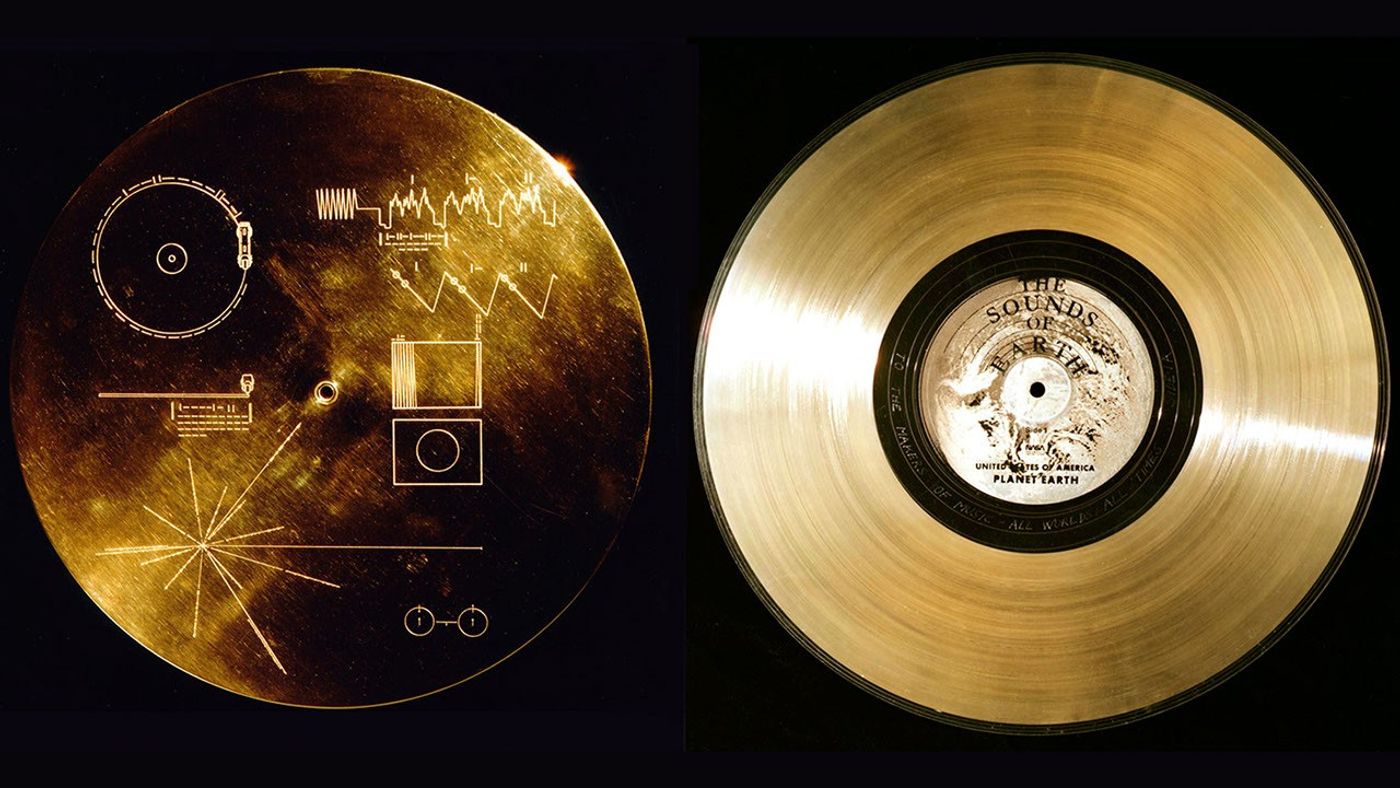
Voyager 1 and 2, launched in 1977, each carry a 12-inch gold-plated record with 115 images, greetings in 55 languages, sounds of Earth and about 90 minutes of music, chosen by a committee chaired by Carl Sagan.
Its cover explains how to play it, repeats the Pioneer pulsar map, and defines time using the same hydrogen transition. A small sample of uranium-238 is electroplated on it, so that whoever finds it could estimate its age from radioactive decay.